Player Context
The game provides the signals GameMantra needs to evaluate the current monetization moment and supported player context.


GAME INTEGRATION
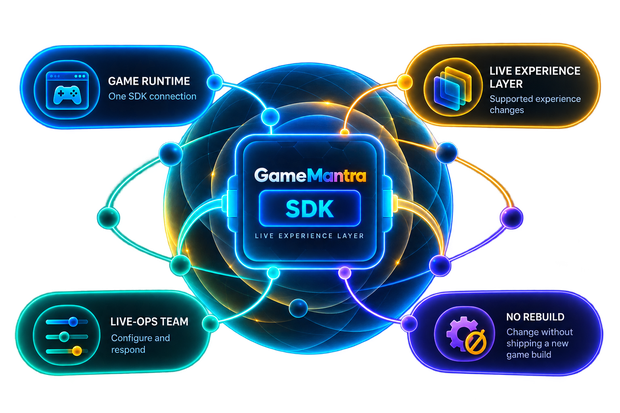
GameMantra connects your game to real-time monetization decisioning, so supported offers, pricing, timing, and experiences can change without rebuilding the game for every change.
Explore Game IntegrationSDK
Connect the game to GameMantra
RUNTIME
Resolve supported monetization experiences in the moment
LIVE
Change supported experiences without rebuilding the game
THE PROBLEM WITH FIXED GAME BUILDS
Player behavior changes from moment to moment, but monetization experiences are often tied to the game build. GameMantra creates a live layer between your game and monetization, so supported experiences can change without rebuilding the game for every update.
Monetization changes require game-build changes
Offer logic is tightly coupled to the client
Every new experience can create another engineering cycle
Live changes are slower to ship
Testing and rollout require more coordination
The game connects to a live monetization layer
Supported offer decisions happen at runtime
Teams can change supported experiences without rebuilding the game
LiveOps can update supported monetization experiences
Measurement and control stay part of the workflow
WHY GAMEMANTRA INTEGRATION
Connect your game once. GameMantra can then provide the runtime connection between player context, monetization decisioning, and supported in-game experiences.
The game provides the signals GameMantra needs to evaluate the current monetization moment and supported player context.
GameMantra resolves the supported monetization response for the current request, including the configured offer experience.
The selected supported experience can be returned to the game without requiring a new game build for every monetization change.
Player responses can be measured while teams retain approval, experiment, rollout, holdout, and rollback controls.
WHAT YOUR GAME CAN CONNECT TO
GameMantra’s SDK and runtime integrations connect your game to the capabilities that power live monetization — from offer decisioning to experimentation, measurement, and control.
01
Resolve a supported offer experience when the player reaches a monetization moment.
02
Change supported offer content, presentation, or configuration without rebuilding the game for every update.
03
Use current response signals to support configured monetization responses for the next opportunity.
04
Use experiments and holdouts to compare experiences before rolling a change out more broadly.
05
Keep supported monetization changes outside the game’s release cycle so LiveOps can move faster.
06
Connect player responses to the monetization workflow so teams can see what changed and decide what to do next.
THE GAMEMANTRA INTEGRATION LAYER
The integration connects the game to the GameMantra runtime, creating a path from player action and current context to a supported monetization response and measurable outcome.
GAME → SIGNAL → DECISION → EXPERIENCE → RESPONSE ↺

The game sends the supported context for the monetization moment the player has reached.

GameMantra resolves the supported monetization response for that request at runtime.

The game presents the supported experience, and the player response feeds the next decision.
Game Teams
Integrate GameMantra into the game runtime and expose the supported signals and monetization surfaces your game needs.
LiveOps Teams
Once integrated, LiveOps teams can work with supported monetization experiences without requiring a new game build for every change.
Engineering Teams
Use GameMantra’s supported runtime integrations to separate monetization changes from the game’s release cycle.
Bring your game architecture and monetization flow. We’ll walk through where GameMantra fits, what the runtime integration enables, and how supported experiences can change after integration.
Your game and runtime architecture
The integration points that matter
The path from player signal to monetization response
Tell us about your game and monetization setup. We’ll show you where GameMantra can connect and what you can change after integration.
GameMantra provides supported SDK and runtime integrations that connect the game to its monetization capabilities. The exact integration points depend on the game runtime and supported implementation.
No, not for supported monetization experience changes. Once the game is integrated with GameMantra, supported changes can be managed through the live monetization layer rather than requiring a new game build for every change.
GameMantra supports native runtime integration along with supported Unity, Unreal, and mobile-framework integrations. Contact us for the current integration and SDK coverage.
No. Runtime decisioning uses the configured and supported decisioning logic. Teams retain control through approvals, experiments, holdouts, measurement, and rollout controls.
The game can send the supported context and request a monetization experience from GameMantra. GameMantra resolves the supported response, the game presents it, and the resulting player response can feed measurement and the next decision.